

Show notes
In this episode of Mythical Masala with Neev, we dive into the origins of one of the greatest epics ever written—the Ramayana. But before we get to the hero, Rama, let’s talk about the man who wrote it all down: Valmiki. Did you know that Valmiki wasn’t always a sage? He started as a bandit and went through an incredible transformation that led him to become the author of this legendary epic.
Get ready for a story filled with wisdom, magical verses, and a few unexpected twists!
Join us as we uncover the birth of this timeless epic and prepare to dive into the adventures of Rama, Seeta, and more
Who is in this episode

- 00:00Hook: how the Ramayana came to be written
- 01:46Valmiki the bandit, and Narada’s wake-up call
- 02:58Two crane birds, and poetry discovered by accident
- 04:12Brahma’s command: write Rama’s story in that verse
- 05:23The Solar Dynasty: kings descended from the Sun
- 07:13Dasharatha’s one big problem: no sons
- 09:02Rishyashringa, the horned sage, and the great yagna
- 10:51Magical pudding from the fire god
- 12:06Three queens, four princes, and a city-wide party
- 13:21The gods’ problem: Ravana’s ten heads and his boon
- 14:15Vishnu’s promise: I will be born as a human
- 14:53School days, and Rama and Lakshmana’s friendship
- 16:07Outro: next time, exile, kidnapping, and epic battles
Read the full transcript
Transcript of the episode audio. Speaker labels: Neev and his co-host.
Neev: Hey there, friends! Welcome to another episode of Mythical Masala with Neev, the podcast where we dive into some of the coolest stories ever, packed with heroes, magical creatures, sneaky demons, and a whole lot of adventure! I’m your host, Neev, and today, I’ve got my mom here with me!
Co-host: Hi everyone! I’m really excited to be here. We’ve got some awesome stories to share today, straight from ancient India. And let me tell you—they’re just as wild and fun as anything from Greek or Norse mythology!
Neev: Exactly! I mean, we’ve got gods who can shape-shift, fly, and even show up in fire to hand out magical pudding. What’s not to love?
Co-host: Magical pudding, huh? Sounds like something that would happen if Zeus had a cooking show!
Neev: Totally! So, let’s start today’s episode with how the Ramayana came to be written. This one’s all about kings, curses, gods, and more! Get comfy, because this story is legendary.
Neev: Before we jump into the story of Rama, we need to talk about the person who actually wrote the Ramayana—Valmiki. Now, Valmiki wasn’t always a sage. Did you know he used to be a bandit?
Co-host: Wait, a bandit? I knew Valmiki was important, but I didn’t know he had such a… colorful past.
Neev: Crazy, right? Valmiki used to rob travelers in the forest to provide for his family, but one day, he met a wise sage named Narada, who told him that his actions would only bring bad karma. That got Valmiki thinking—he decided to change his ways. He left behind his life of crime and began meditating for years. Eventually, he became a sage, respected for his wisdom and kindness.
Co-host: That’s quite the transformation! And what’s really fascinating is that ancient stories like these often show people redeeming themselves through meditation or seeking wisdom. It’s a major theme in Indian mythology—people changing for the better after a moment of realization.
Neev: Yeah, it’s a major glow-up! Valmiki eventually became a respected sage. And one day, he was walking by the Tamasa River. Imagine the scene: clear water, birds chirping, a soft breeze. Valmiki loved nature, and while he was walking, he saw two Krancha birds playing together, totally carefree.
Co-host: Krancha birds is a type of crane. These two were a couple, right? They seem to be lost in love.
Neev: They were having the best day ever—until a hunter appeared and shot one of the birds!
Co-host: Oh no! Poor birds. That must’ve been hard to watch.
Neev: Valmiki was devastated. He saw the female bird crying over the loss of her mate, and without even thinking, he cursed the hunter. But what’s amazing is that the curse came out in this beautiful, rhythmic verse—like poetry! Valmiki was as shocked as anyone. He didn’t expect that.
Co-host: It’s like he discovered poetry by accident. And speaking of poetry, Valmiki is sometimes compared to Homer, the Greek poet who wrote the Iliad and Odyssey. Both Valmiki and Homer were storytellers who captured epic journeys with rhythm and verse.
Neev: Yeah, except Homer didn’t have gods showing up to help him with his writing! Just as Valmiki was processing what happened, the god Brahma appeared.
Co-host: Now, for anyone unfamiliar, Brahma is the creator god in Hinduism. He’s part of what’s called the Trimurti, or the Hindu trinity. Alongside him are Vishnu, the preserver, and Shiva, the destroyer. Brahma’s role is to create the universe and everything in it.
Neev: Right! So when Brahma appeared, he told Valmiki, “That beautiful verse you just recited? I want you to use that style to write the story of Rama, one of the greatest heroes ever.” And that’s how Valmiki ended up writing the Ramayana! Co-host That’s amazing. You know, a lot of these ancient epics were passed down orally before being written down.In this case, Valmiki got divine approval to write the Ramayana.
Neev: Yep! So, let’s dive into the story itself. But first, we need to talk about Rama’s family.
Neev: Rama wasn’t just born into any family—he was born into the Suryavanshi, or Solar Dynasty, which claimed descent from the Sun God, Surya. This made them pretty important.
Co-host: The Solar Dynasty wasn’t just powerful—it was known for producing wise and just kings. These rulers were expected to be as reliable as the sun itself, providing light, warmth, and protection to their people.
Neev: The Sun God, Surya, is super important in Hindu mythology. In a way, he’s similar to the Greek god Apollo, who also represented the sun, light, and truth. Surya was seen as a powerful and reliable god because the sun shines every day, giving life to everything on Earth.
Co-host: It’s interesting how many cultures have Sun gods—there’s also Ra in Egyptian mythology. I guess every ancient culture understood how important the sun was for survival.
Neev: The kings of this dynasty were brave and wise. One of the most famous was Harishchandra, who was so honest, he never told a lie. Ever!
Co-host: Harishchandra’s story is legendary. He even sacrificed his kingdom to keep his word. That’s some serious dedication to honesty.
Neev: No kidding! Another famous king was Bhagirath, who brought the Ganga River down from the heavens to Earth. His devotion was so strong that the Ganga, one of the holiest rivers in India, is still considered sacred today.
Co-host: Looks like we will have to tell the stories of Harishchandra and Bhagirath in a future episode.
Neev: We definitely will. Back to the Solar Dynasty, these kings set a pretty high standard for future rulers. The Solar Dynasty’s capital was Ayodhya, which was ruled by King Dasharatha. Ayodhya was like the ancient version of a bustling city—full of grand palaces, wide streets, and markets selling spices, jewels, and textiles. Imagine a place where everything is running smoothly—farmers are tilling fields, soldiers are guarding the city, and the markets are filled with spices and jewels. Think of it like a combination of ancient Rome and Athens!
Co-host: Sounds like a dream city! But not everything was perfect in Ayodhya, was it?
Neev: Exactly. Even though King Dasharatha ruled over this amazing city, he wasn’t happy. He had one big problem-Even though he had three wives, —he didn’t have any children. And for a king, that’s a huge deal.
Co-host: Back in those days, having a son to carry on the family line was super important, especially for royalty. Without an heir, there was no one to take over the throne, which could lead to chaos or even the end of the dynasty.
Neev: That’s exactly what Dasharatha was worried about. Without a son, the future of the Solar Dynasty was in danger. King Dashratha decided to ask the gods and sages to help him in this matter. He called a counsel of his learned men and asked if they knew how he could have sons which would continue his line and rule the Kingdom wisely as he had done for so many years. These men consulted each other and told the king to call upon Sage Rishyashringa who lived deep in the forest of the Kingdom. He was also known as the sage with the horn and had never lived in human company. He had the power to bring rain to thirsty landand the power to produce Sons for childless Kings on account of his truly terrifying ascetic practice. Dashrath decided that he would send for the sage and ask him to perform a spiritual ritual called yagna —a sacred fire sacrifice.
Co-host: Yajnas were really important in ancient India. They were a way to connect with the gods and ask for blessings. The fire, called Agni, was seen as a messenger between humans and gods. So, if you needed something big—like a son to continue your line—performing a yajna was a way to go straight to the gods for help.
Neev: This wasn’t the only famous yajna in Indian mythology. There’s also the Ashwamedha Yajna, which was performed by kings to prove their supremacy. It involved letting a horse roam freely, and any kingdom the horse wandered into had to either submit or fight the king. Back to Ayodhya, This yajna wasn’t just any yajna. It was special because it was meant to help Dasharatha have sons. Rishyashringa did as the king asked and there was a grand ceremony performed with the King and his Queens in attendance. The entire kingdom gathered to watch as the priests chanted mantras and made offerings to the fire. Everyone held their breath, waiting to see if the gods would answer.
Neev: As the ritual was coming to an end, something amazing happened! The fire god Agni appeared from the flames, red in color wearing crimson clothes and holding a golden bowl of kheer. Now, kheer is a sweet, delicious pudding made of rice and milk, but this wasn’t just any kheer. Agni told Dasharatha, “If you give this kheer to your wives, they will bear you sons!”
Co-host: Whoa, so instead of a stork delivering babies, we have magical pudding from a fire god?
Neev: Yeah, who needs storks when you’ve got a divine dessert? So, Dasharatha carefully divided the kheer among his three wives—Kaushalya, Sumitra, and Kaikeyi. And lo behold once they had the Kheer, the sadness of the palace turned into happiness as all three queens became pregnant and produced the Sons that the king wanted
Co-host: And each of these queens had her own special role in the story, didn’t they? Let’s talk about them for a moment.
Neev: Right! Kaushalya, the eldest, who gave birth to Rama, who was born with a face like the moon and had all the marked signs of becoming a great King when he would grow up. Kaushalya was wise and compassionate, the perfect mother for the hero of our story. Then there was Sumitra, who had the twins Lakshmana and Shatrughna. Sumitra was known for her strength and loyalty—qualities her sons would later show in battle. And finally, there was Kaikeyi, the youngest, who gave birth to Bharata who was the second eldest of Dashratha’s sons. Kaikeyi was bold and clever, but her ambition would cause some trouble later on.
Co-host: I am sure at that time, Ayodha was just focused on celebrating the birth of these princes.
Neev: Yes, There were banners that flew from top of the white buildings and streets were strewn with flowers as citizens danced and sang, and shared food and drink with each other. It was like one big happy party. King Dashratha was really happy as he gazed lovingly at his sons and he thanked the gods for answering his prayers. He distributed gifts among all people; cows and clothes drills and food and even toys for children.
Neev: While all of this was happening on Earth, the gods in heaven were facing a huge problem. There was a demon king named Ravana, and trust me, he wasn’t your ordinary bad guy. Ravana had ten heads and was causing chaos everywhere.
Co-host: Ten heads? That’s a lot of hats to keep track of. What was Ravana using all those heads for, anyway?
Neev: Who knows! but it definitely made him a lot more intimidating!. Here’s the thing—Ravana was invincible to gods, demons, and supernatural beings because of a boon he received from Brahma. No one could defeat him.
Co-host: That sounds like a serious problem. How did anyone plan to stop him?
Neev: Well, Ravana made one big mistake—he didn’t ask for protection from humans! So the gods saw their chance. They went to Lord Vishnu, the preserver god in the Hindu trinity, and begged him for help. Vishnu agreed and said, “I will be born as a human to defeat Ravana.” And that’s how Rama came into the picture—he was Vishnu’s avatar on Earth.
Neev: So, now that we have Rama and his brothers—Bharata, Lakshmana, and Shatrughna—the kingdom of Ayodhya was buzzing with excitement. The princes grew up learning all the skills they needed to become great kings and warriors. They were sent to study under Sage Vasishtha, a wise and powerful teacher.
Co-host: So even though they were princes, they still had to go to school?
Neev: Yup! No special treatment for them. They lived in an ashram, which is kind of like a school, where they learned everything from archery and battle tactics to philosophy and how to govern a kingdom. Imagine a school where instead of math homework, you’re practicing with a bow and arrow!
Co-host: That sounds way cooler than regular school!
Neev: During this time, the bond between Rama and Lakshmana grew super strong. Lakshmana was always by Rama’s side, like a true best friend. They did everything together, and Lakshmana’s loyalty would be key to the adventures that lie ahead. Foreshadowing Future Conflicts
Neev: But, of course, Rama’s life isn’t always going to be easy. Even though the kingdom of Ayodhya is peaceful now, things are going to take a dramatic turn. There will be an exile, a kidnapping, and some epic battles. Trust me, the adventure is only beginning.
Neev: And that’s all for today! In the next episode, we’re going to dive into some of those epic battles, daring rescues, and see how Rama steps up to become the hero we all know and love.
Co-host: Thanks for joining us, everyone! Make sure to tune in for the next episode of Mythical Masala with Neev.
Neev: See you next time! And remember—every great adventure starts with a little magic… or maybe a bowl of magical pudding!
Co-host: And some masala!
Printable for this episode
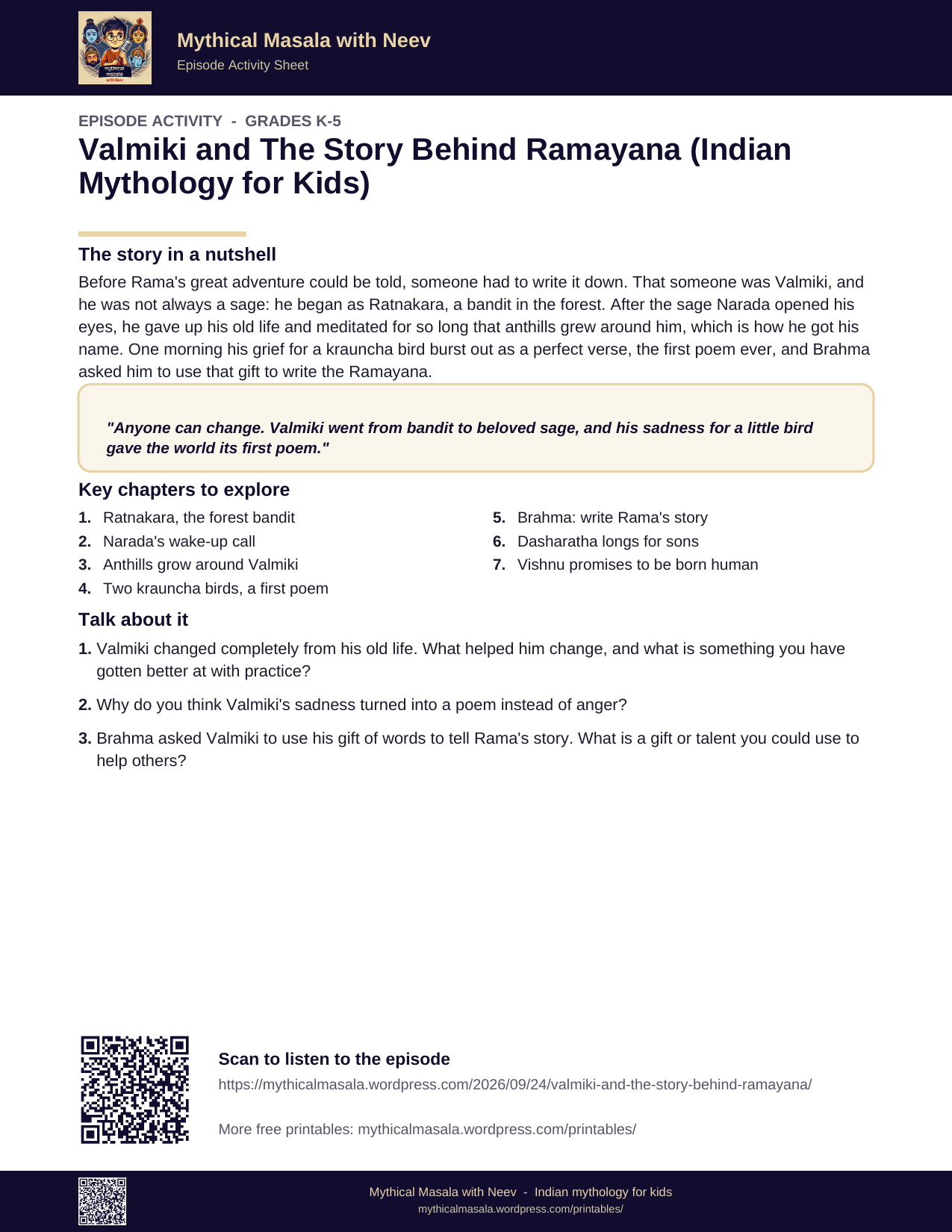
Frequently asked questions
Who was Valmiki?
Valmiki was the sage who composed the Ramayana, one of the oldest and greatest epics ever written. He is honored as the Adi Kavi, the first poet of Sanskrit literature, because the beautiful verses he created gave Rama’s story the immortal form that millions still cherish today.
Was Valmiki always a sage?
No, and that is what makes his story so inspiring. Valmiki began life as Ratnakara, a bandit who robbed travelers on the forest roads to feed his family. When he realized that no one would share the burden of his sins, he abandoned his old life and turned toward goodness.
How did Valmiki get his name?
After giving up robbery, Valmiki sat in meditation for so many years without moving that anthills grew up all around his body. In Sanskrit, an anthill is called valmika. When he finally rose from his penance, transformed and enlightened, he took the name Valmiki.
What inspired Valmiki to write the Ramayana?
One morning Valmiki saw a hunter cruelly kill one of a pair of loving krauncha birds, and his grief burst out as a perfect Sanskrit verse. That spontaneous verse was the first shloka ever composed. The god Brahma then appeared and asked him to use this divine gift of poetry to tell Rama’s story.
Why is the Ramayana still important today?
The Ramayana has guided millions of people for thousands of years with its lessons about duty, love, and doing what is right. Festivals like Diwali and Dussehra celebrate its great moments, and its heroes remain ideals of character. Valmiki’s epic proves that a great story truly never dies.
Got a question or a story request?
Send it in. Many listener questions get answered on the show.
Listen and follow


Related episodes

Rama’s Fights Demons and Ahalya's Curse
In this episode of Mythical Masala with Neev, we dive deep into the action-packed journey of Rama as he faces his first real battle! Alongside his brother Lakshmana, and under the guidance of the powerful Sage Vishwamitra, Rama is about to encounter terrifying demons, dangerous forests, and an epic fight that will define his future. As the story unfolds, Rama's compassion and strength are put to the test once again. Join us as we unravel another legendary chapter in the Ramayana with action...

The Bow of Shiva: Rama’s Triumph in the Swayamvara
In this episode of Mythical Masala with Neev, we follow Rama, Lakshmana, and Sage Vishwamitra as they embark on a journey to the kingdom of Mithila. But this is no ordinary trip—King Janaka has set up a grand swayamvara to find a worthy husband for his daughter, Princess Seeta. With Lord Shiva’s legendary bow as the ultimate challenge, will anyone succeed in winning Seeta’s hand? Tune in as we dive deep into this legendary tale of strength, destiny, and love.

Sudarshan Chakra: How Vishnu Got His Spinning Disc and Why Durvasa Ran
Where did Vishnu's spinning disc, the Sudarshan Chakra, come from? It starts with a thousand lotus flowers, a test from Shiva, and one flower that goes missing. Neev and his mom tell the story of how Shiva gave Vishnu the chakra, including a lesser-known version where Vishnu tests it on Shiva himself. Then the chakra goes to work, guarding King Ambarisha, a kind king keeping his Ekadashi fast. When the hot-tempered sage Durvasa turns up late for lunch and loses his temper over a single sip o...