

Season 1, Episode 1
How Ganesha Became the Beloved Elephant God!
Player not loading? Open the audio file.
Show notes
Welcome to the very first episode of Mythical Masala with Neev! We’re kicking things off with one of the most beloved gods in Hindu mythology—Ganesha, the Elephant-headed god of wisdom and new beginnings. Ever wondered why Ganesha has an elephant’s head or why he’s always seen riding a mouse? In this episode, we uncover the fascinating origin story of Ganesha, exploring his special connection with his parents, Shiva and Parvati, and how he became the remover of obstacles.
Tune in to learn why Ganesha is known as the remover of obstacles and why his story is the perfect way to start any new journey!
Who is in this episode

- 00:00Hook: starting with the god of new beginnings
- 02:24Meet Shiva, Parvati, and Kartikeya
- 03:39The race around the universe
- 06:07Parvati makes a boy out of clay
- 07:25Shiva’s anger, and a terrible mistake
- 08:21The elephant head brings Ganesha back to life
- 09:54The remover of obstacles
- 11:08Ganesha’s symbols: the axe, the lotus, the modaks, and the mouse
- 14:35What Ganesha teaches us: wisdom, forgiveness, and parents
- 15:29Outro: every new journey begins with Ganesha
Read the full transcript
Transcript of the episode audio. Speaker labels: Neev and his co-host.
Neev: Hey, everyone! Welcome to Mythical Masala with Neev, where we dive into the most magical and legendary stories from ancient India. I’m your host, Neev, and today is a very special episode, because we’re starting with a god who’s known for blessing new beginnings. Whether you’re starting a project, writing an exam, or even beginning a new podcast like we are, you definitely want this god on your side. Any guesses?
Co-host: Well, if you haven’t figured it out yet, here’s a clue: he’s got the head of an elephant, a sweet tooth the size of a mountain, and loves to help people remove obstacles from their path. Any ideas?
Neev: That’s right—it’s Ganesha! He’s the god of wisdom, the remover of obstacles, and the lord of new beginnings. So of course, it only makes sense to kick off our podcast with a story about him! And trust me, this story’s got everything—family drama, magical transformations, and, yes, a race around the universe!
Co-host: Oh, and don’t forget—there’s plenty of sweets involved. Ganesha loves his laddoos, which are these delicious, round Indian sweets. But before we get into the desserts, let’s start at the beginning, shall we?
Neev: So, let’s begin with Ganesha’s family. He’s the eldest son of Shiva, the god of destruction, and Parvati, the goddess of love and fertility. Now, Shiva and Parvati are a bit of a power couple in Indian mythology, Shiva’s known for being a bit intense—after all, he’s got a job title like “destroyer.” But Parvati? She’s nurturing, loving, and balances Shiva’s fiery personality with her calm and grace. Together, they make a pretty powerful duo. And Ganesha’s their firstborn. But unlike most families, where the biggest fight might be over who gets the TV remote, Ganesha’s family had… bigger issues.
Co-host: Like, say, heads being cut off. But don’t worry, we’ll get to that soon enough. But before we do, Did you know that Ganesha has a younger brother named Kartikeya? Kartikeya is the god of war, often depicted riding a peacock. So, you can imagine the sibling rivalry between these two!
Neev: Sibling rivalry, huh? I bet their version of a race wasn’t a casual run in the backyard. No, these two had a race around the entire universe! Talk about extreme sibling competition!
Neev: Alright, so here’s the story. One day, Ganesha and Kartikeya were arguing over who should be worshipped first. You know, normal sibling stuff—except they’re gods. Their parents, Shiva and Parvati, came up with a solution: the brothers would have a race around the universe. Whoever won would be worshipped first. Kartikeya, being the warrior and action-packed god that he is, jumped on his peacock and took off!
Co-host: That’s right! Kartikeya was all about speed. He probably thought, “I’ve got this in the bag. I mean, how can anyone beat a peacock in a race?”
Neev: But Ganesha? He didn’t even try to outfly Kartikeya. Instead of bolting around the universe, Ganesha used his brain—after all, he’s the god of wisdom. Instead of traveling around the physical universe, he simply circled around his parents, Shiva and Parvati. Why? Because they are considered the source of all life and the universe itself.
Co-host: Genius move, right? It’s like winning the game by thinking outside the box. While Kartikeya was off flying through galaxies, Ganesha found the simplest and wisest solution.
Neev: And guess what? He won the race! Shiva and Parvati were so impressed with his wisdom that they declared Ganesha the winner. That’s why Ganesha is often worshipped before any other god—his wisdom comes first!
Co-host: I love that. It’s like a reminder that sometimes, the solution isn’t in rushing ahead but in thinking through the challenge. Ganesha shows us that brains can beat brawn any day.
Neev: Yeah, and there’s another lesson here too—one that’s really important. Ganesha didn’t just win because he was smart; he won because he understood something deep. He knew that his parents, Shiva and Parvati, were the most important part of his universe. By respecting and honoring them, he found the ultimate shortcut. In a way, Ganesha teaches us that respecting and valuing our parents is one of the wisest things we can do. After all, they’re our first teachers and guides. So, if there’s one thing to take away from this part of the story, it’s that respecting and cherishing your parents can open up a whole universe of possibilities for you—just like it did for Ganesha!
Co-host: But now we’ve got to answer the big question: why does Ganesha have the head of an elephant?
Neev: Ah, the famous story! There are many versions of how Ganesha got his elephant head, but let’s stick to one of the most popular ones. So, one day, Parvati was home alone while Shiva was out doing Shiva-like things. Parcati wanted to take a bath. Now, being the goddess of the house, she wanted some privacy, but there was no one to guard the door while Shiva was away. So, she decided to create a protector. And, in true goddess fashion, she didn’t just ask someone to help her—nope, she created a little boy out of dirt from her own body! She shaped him from dirt, breathed life into him, and named him Ganesha. Parvati told Ganesha to guard the door and not let anyone in while she bathed.
Co-host: Wow! You can tell Parvati was really powerful. So, guarding the door…Seems like a simple task…
Neev: You’d think so, but here’s where things take a dramatic turn. While Ganesha was guarding the door, Shiva came home. Now, Ganesha had never met Shiva before, so when Shiva tried to enter, Ganesha stopped him, refusing to let him in!
Co-host: (Acting) YOU CAN’T GO IN! I have strict orders!
Neev: And Shiva, being the powerful god that he is, didn’t exactly take kindly to being denied entry into his own home. He didn’t recognize Ganesha either.
Co-host: GET OUT OF MY WAY! BOY! Don’t you know who I am!
Neev: In his anger—and without realizing Ganesha was his own son—Shiva chopped off Ganesha’s head!
Co-host: Talk about family drama!
Neev: When Parvati came out and saw what had happened, she was devastated.
Co-host: (Acting) Oh No! What have you done my lord!
Neev: Parvati told Shiva who Ganesha was, and Shiva immediately regretted what he had done.
Neev: Shiva knew he had to fix things, and fast. So he sent his followers out to find the first living creature they could, whose head could be used to bring Ganesha back to life.
Co-host: And wouldn’t you know it—the first creature they came across was…
Neev: an elephant! So, they brought back the elephant’s head, and Shiva attached it to Ganesha’s body. With his new elephant head, Ganesha was brought back to life.
Co-host: I have a question - couldn’t shiva put the original head back? Or couldn’t Parvati have created another Ganesha out of dirt like before?
Co-host: That’s a great question. There are many variations to that part of the story. Some say the head was destroyed in a big way so it could not be put back. Some say there was an ardent Shiva devotee called Gajasura - an elephant, who wanted to reside within Shiva. When Shiva came back from some war he had with him the head of Gajasura, immediately put it on.
Neev: And while it wasn’t exactly a perfect match, it turned out to be a pretty good one. Ganesha’s large elephant ears help him listen to the prayers of his people, and his elephant strength symbolizes his power to remove obstacles. Plus, elephants are known for their wisdom and memory, which fit perfectly with Ganesha’s role as the god of intellect and wisdom. So, in a way, the elephant head is even better than his original one.
Co-host: So, what’s Ganesha known for today?
Neev: Well, he’s the Remover of Obstacles, which is why people pray to him before starting anything important—whether it’s a new business, a journey, or even something like, well, starting a podcast! And Ganesha isn’t just a remover of obstacles in the literal sense, but also in the mental and emotional sense. He helps people clear doubts, focus their minds, and overcome challenges. In fact, you’ll often see statues or images of Ganesha placed at the entrances of homes, shops, and temples. He’s there to bless the place and make sure nothing stands in the way of success. And let’s not forget—he’s the god of wisdom, which is why students often pray to him before exams!
Co-host: It’s like having a good luck charm that clears the path for success.
Neev: And here’s something cool—when you look at Ganesha, you’ll often see him holding a bunch of different things that symbolize his powers. For example, one of the things he holds is an ax, which he uses to cut down obstacles that get in people’s way.
Co-host: So, if there’s something blocking your way—be it a physical obstacle or just a tricky math problem—you can count on Ganesha to help you clear it out, ax and all!
Neev: Right! And another important symbol he holds is a lotus flower, which stands for purity and enlightenment. Even though a lotus grows in muddy water, it blooms beautifully above the surface, untouched by the mud. It’s like a reminder that even if life gets messy, we can rise above it and stay pure and focused.
Co-host: Ganesha is also very famous for—his love for sweets. Specifically, his favorite treat is a sweet dumpling called a modak.
Neev: Oh, I love modaks! For those of you who haven’t had one, they’re delicious dumplings made with rice flour, stuffed with sweet fillings like coconut, jaggery (which is a type of sugar), and cardamom. They’re steamed or fried, and they’re so good.
Co-host: Yeah, and Ganesha loves them so much that they’ve become one of his main symbols!
Neev: You’ll often see a plate of modaks next to him in pictures and statues. But here’s something cool—Ganesha’s love for sweets isn’t just about his sweet tooth. It actually symbolizes the rewards of wisdom. You know, like how after working hard to solve a problem or achieve something, there’s a sweet reward at the end. During Ganesh Chaturthi, the festival dedicated to Ganesha, people offer him tons of laddoos and modaks. It’s a celebration filled with colors, music, and—most importantly—sweets.
Neev: So, it’s like Ganesha is telling us: work hard, use your wisdom, and in the end, life will reward you with something sweet.
Co-host: Alright, Neev, You often see a tiny mouse at his feet in pictures and statues, right? What’s the story there?
Neev: Ah, yes—the mouse, or Mushika as it’s called in Sanskrit. This little mouse is actually Ganesha’s vahana, or vehicle. Now, at first glance, it might seem strange that a huge, strong god like Ganesha rides around on something as small as a mouse. I mean, wouldn’t a god with an elephant head prefer something bigger, like an elephant? But there’s a deeper meaning here. The mouse represents humility and smallness. No matter how big or powerful Ganesha is, riding the mouse reminds us that he stays humble. Also, a mouse can sneak into the tiniest of spaces, symbolizing how Ganesha can help solve the smallest of problems, even the ones that seem too tiny to notice.
Co-host: That’s awesome! So Ganesha can tackle the biggest of obstacles with his wisdom, and also handle the smallest issues—thanks to his mouse.
Neev: Plus, the mouse is known to be a bit mischievous and sneaky, and it reminds us of the ego. Ganesha riding the mouse symbolizes his control over ego, showing that no matter how tricky our ego can be, wisdom can keep it in check.
Co-host: So what can we learn from Ganesha?
Neev: First, he teaches us that wisdom is more powerful than physical strength. Remember how he won the race by thinking smart, not fast? He also reminds us that life is full of obstacles, but with patience, determination, and a little wisdom, we can overcome them. And Ganesha’s story also teaches us about the importance of forgiveness and family. Even though Shiva made a terrible mistake, Ganesha was brought back to life and became even stronger. So whether you’re starting a new project or just need some help in life, Ganesha is the god to call on for a little wisdom and a lot of blessings.
Neev: And that’s it for today’s episode of Mythical Masala with Neev! I hope you enjoyed learning all about Ganesha—the remover of obstacles, the lover of sweets, and the god of wisdom. He’s definitely someone you want on your side when life gets tricky.
Co-host: Thank you so much for joining us! Be sure to tune in for the next episode, where we dive into more magical stories from Indian mythology.
Neev: See you next time! And remember, every new journey begins with a blessing from Ganesha—so don’t forget to offer him a sweet or two or a plate full of modaks!
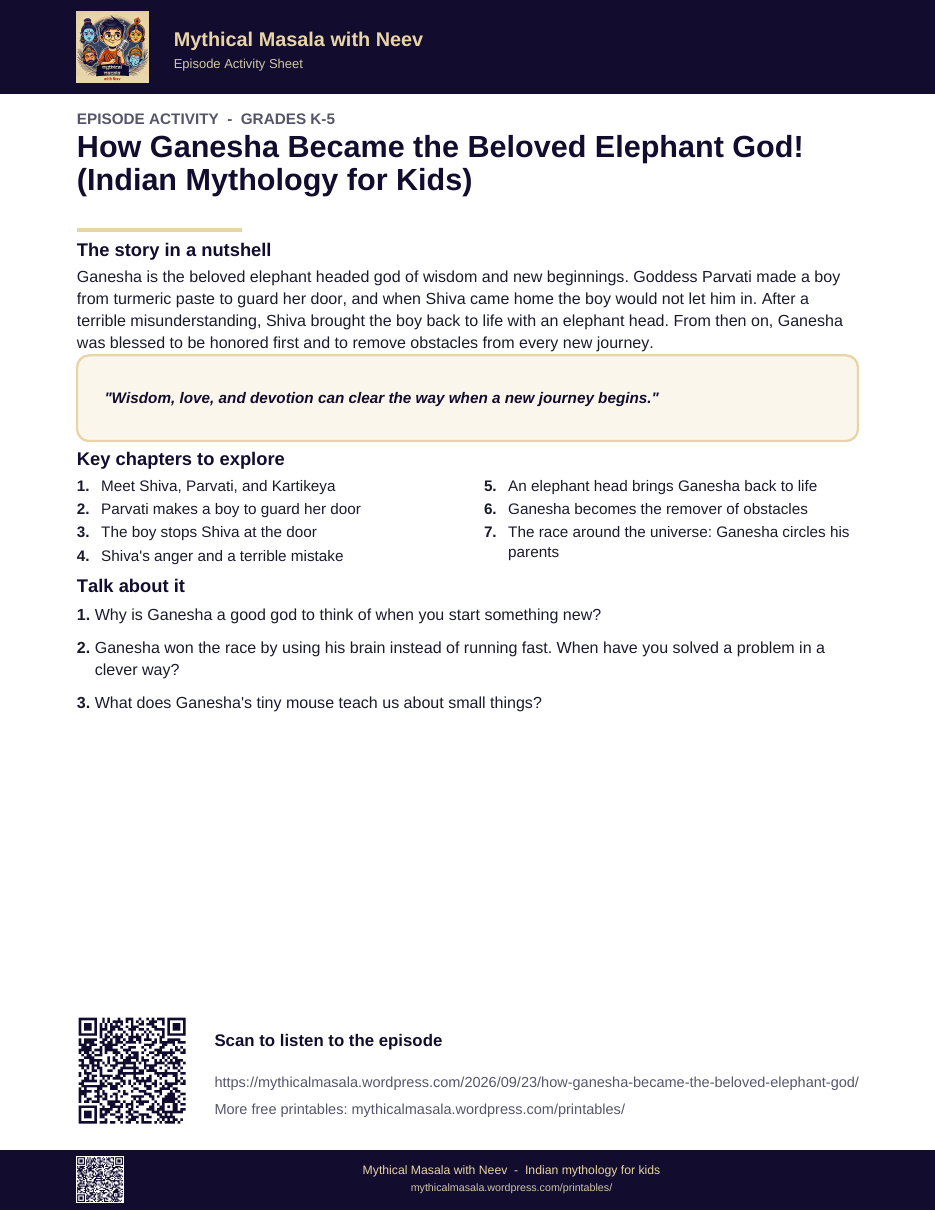
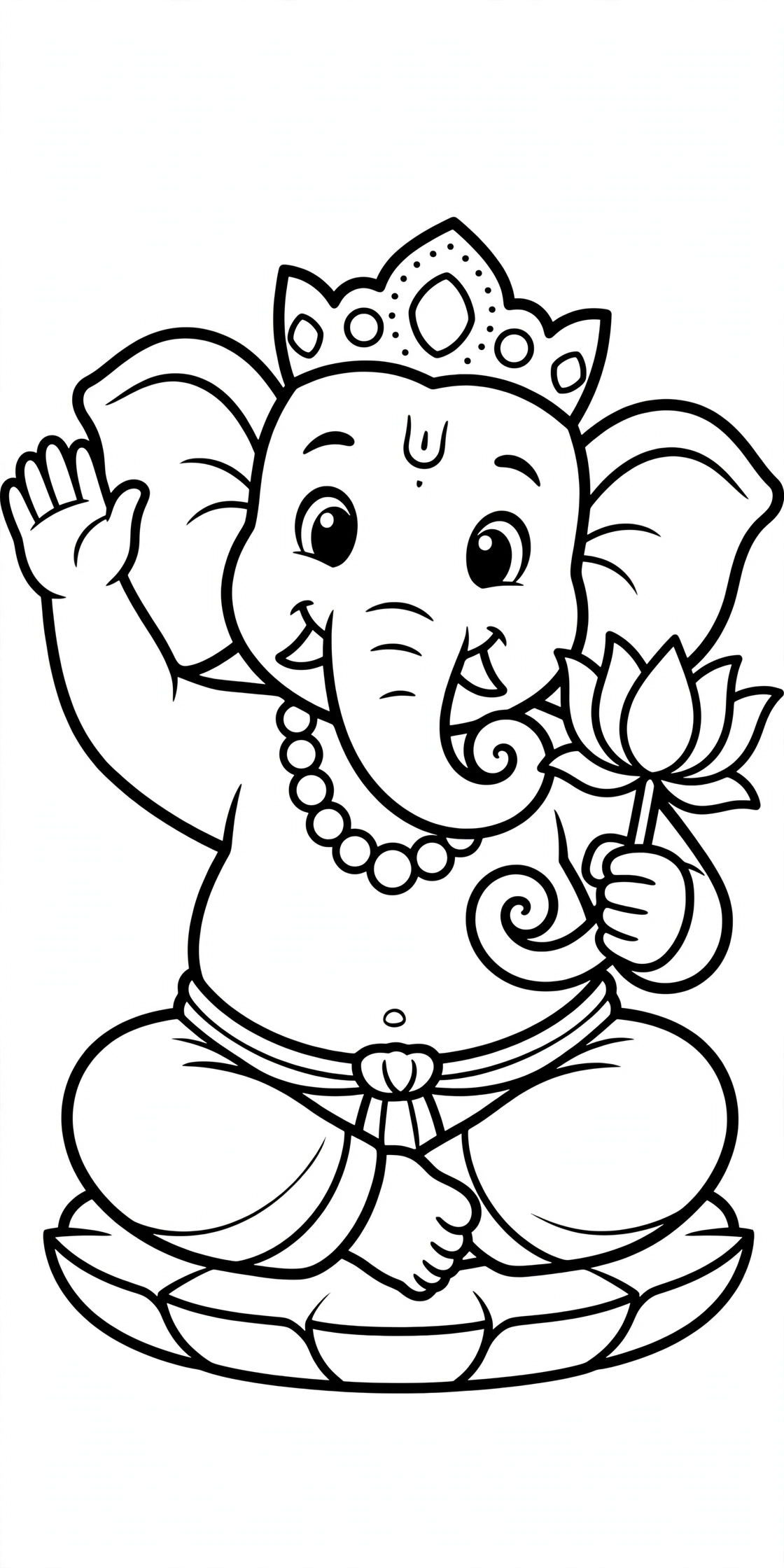
Printable for this episode
Frequently asked questions
Why does Ganesha have an elephant head?
Goddess Parvati created a boy from turmeric paste to guard her door while she bathed. When Shiva returned home, the boy blocked him, and in the misunderstanding that followed, Shiva cut off his head. To make things right, Shiva replaced it with the head of the first creature found, an elephant, and brought the boy back to life as Ganesha.
Why does Ganesha ride a mouse?
Ganesha’s tiny vehicle is the mouse, Mushika, and the pairing is full of meaning. The mouse represents desire, which can nibble away at us if left uncontrolled, yet Ganesha keeps it under perfect control. It also shows that no task is too small and no obstacle too tiny for him to overcome.
Why is Ganesha called the remover of obstacles?
Ganesha earned this title after Shiva blessed him to be worshipped before every other god and at the start of every new venture. People pray to him before exams, journeys, weddings, and new projects so that nothing blocks their path. His blessing is believed to clear the way for success.
Who are Ganesha’s parents?
Ganesha’s parents are Lord Shiva, the destroyer and transformer, and Goddess Parvati, the divine mother. He is deeply devoted to them both. In the famous race around the world against his brother Kartikeya, Ganesha won by simply walking around his parents, declaring they were his entire universe.
Why is Ganesha worshipped first among all gods?
Tradition says no prayer, festival, or new beginning starts without honoring Ganesha first. This custom comes from Shiva’s blessing after Ganesha’s devotion proved unmatched. Starting with Ganesha is a way of asking for a smooth, obstacle-free path in whatever comes next.
Got a question or a story request?
Send it in. Many listener questions get answered on the show.
Listen and follow


Related episodes

Vishwamitra vs. Vasishtha: A Tale of Power
In today’s episode of Mythical Masala with Neev, we’re exploring the dramatic and powerful story of Vishwamitra, a king who gave up everything to become one of the greatest sages in Indian mythology. From his rivalry with Sage Vasishtha to his quest for ultimate spiritual power, Vishwamitra’s story is filled with battles, tests of will, and incredible transformations. This episode is packed with epic moments, fascinating characters, and life lessons about determination and growth. If ...

Rama’s Fights Demons and Ahalya's Curse
In this episode of Mythical Masala with Neev, we dive deep into the action-packed journey of Rama as he faces his first real battle! Alongside his brother Lakshmana, and under the guidance of the powerful Sage Vishwamitra, Rama is about to encounter terrifying demons, dangerous forests, and an epic fight that will define his future. As the story unfolds, Rama's compassion and strength are put to the test once again. Join us as we unravel another legendary chapter in the Ramayana with action...

Sudarshan Chakra: How Vishnu Got His Spinning Disc and Why Durvasa Ran
Where did Vishnu's spinning disc, the Sudarshan Chakra, come from? It starts with a thousand lotus flowers, a test from Shiva, and one flower that goes missing. Neev and his mom tell the story of how Shiva gave Vishnu the chakra, including a lesser-known version where Vishnu tests it on Shiva himself. Then the chakra goes to work, guarding King Ambarisha, a kind king keeping his Ekadashi fast. When the hot-tempered sage Durvasa turns up late for lunch and loses his temper over a single sip o...